
Neuroinclusion works best when everyone works together.
I’ve been thinking a lot about the unseen load many neurodivergent people carry at work.
Some of us have always known we’re neurodivergent.
Some of us only find out later in life.
And if you’ve spent years masking, it can take time – and a lot of patience – to understand what you need to thrive. All while navigating a workplace that probably wasn’t designed with your neurotype in mind.
On top of that, many neurodivergent employees are leaned on to educate their manager or organisation at the same time.
And that’s a lot for one person to hold.
The responsibility for getting the right support at work shouldn’t sit solely with the neurodivergent colleague.
And it isn’t just an HR initiative either.
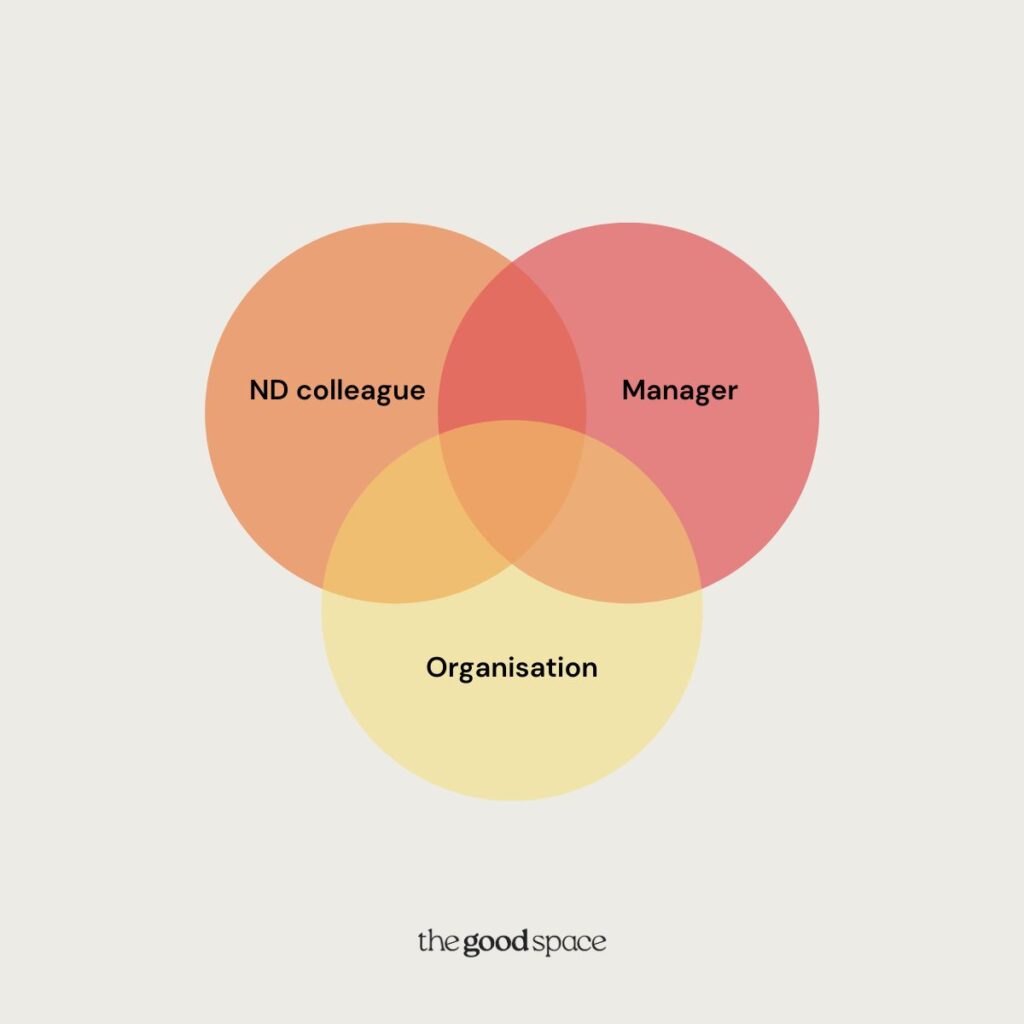
In my experience, people thrive when three areas work together.
The neurodivergent colleague
Understanding what helps – and what doesn’t – takes time.
So does feeling safe enough to experiment, talk about needs and revisit them as things evolve.
Self-awareness grows in layers. And confidence grows with safety.
Neither can flourish if the pressure to get it right sits entirely on the individual.
What matters most is having the psychological safety to explore what enables you to do your best work.
Their manager
Managers play a huge part in whether someone feels safe enough to speak up.
Supportive managers:
- recognise that everyone is different (even two people with the same neurotype)
- stay curious rather than assuming
- check in regularly
- listen with care
- create space for honest conversations without fear of judgment or consequences
A manager doesn’t need to be an expert in ADHD, autism, dyslexia or any other neurotype.
They simply need to be willing to learn, listen and adapt.
That alone can transform someone’s daily experience.
The organisation
When neuroinclusion is truly embedded, you see it everywhere:
In systems. In processes. In strategy. In culture.
Across the whole employee experience – recruitment, onboarding, development, performance, communication, all of it.
It’s the difference between support being consistent…
or a postcode lottery that depends entirely on who your manager happens to be.
Organisational commitment is what shifts inclusion from nice to have to this is how we work here.
When these three align, people thrive
When even one part is missing, work can feel harder than it should, and that struggle often goes unseen.
Neuroinclusion isn’t about having all the answers.
None of us do.
It’s about being open, staying curious and working together so people feel supported, understood and able to do their best work.
What do you think?
I’d love to hear your thoughts.