
ADHD friendly ways to protect your energy this December.
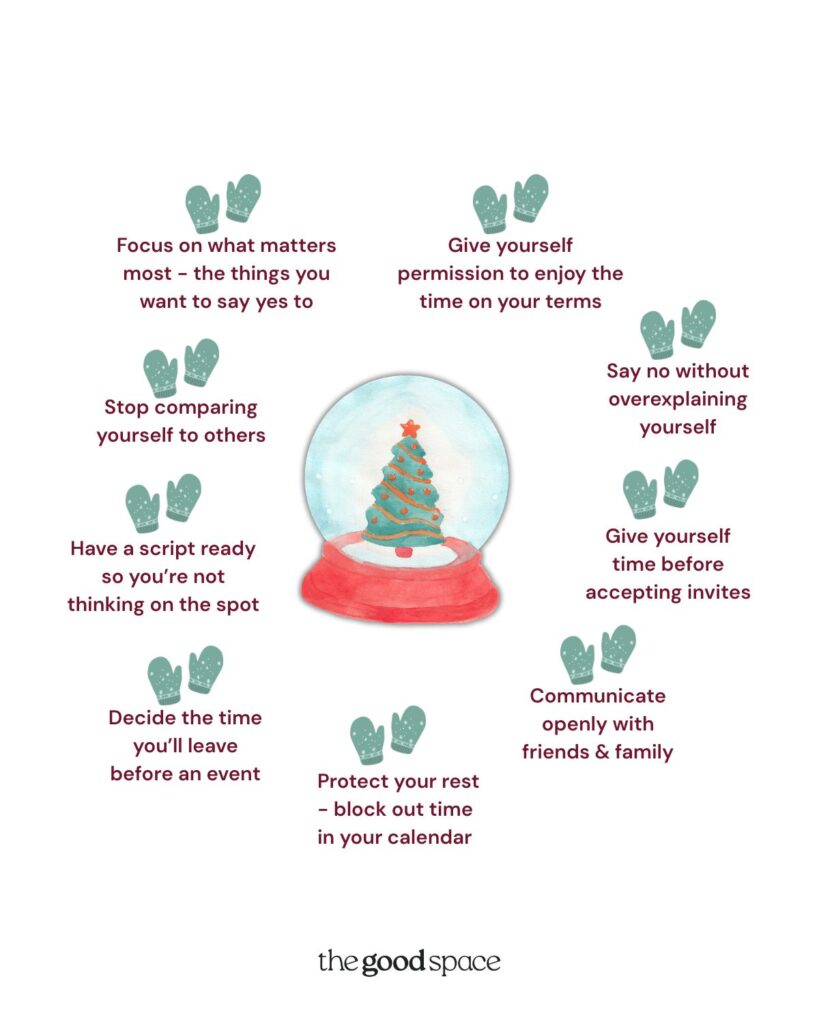
If you have ADHD and struggle with boundaries in December, you’re not alone.
As a recovering people-pleaser with ADHD, setting boundaries – and actually sticking to them – can feel almost impossible. Before I know it, I’ve said yes to things I don’t have the capacity for. And by the time the month is in full swing, I’m exhausted, overstretched, and wondering how I got here again.
Sound familiar?
It’s not because we’re weak or even necessarily bad at saying no. It’s because our brains genuinely work differently.
And this time of year can be especially hard for us.
Why this time of year can be challenging for ADHD brains
Here are some of the reasons many ADHDers struggle more at this time of year:
Rejection Sensitivity Dysphoria
RSD can make “no” feel emotionally risky. Even if the invitation is low-stakes, our brains can catastrophise the outcome.
Impulse regulation becomes harder
In the moment, avoiding disappointing someone can override what we actually need.
Later, we realise we’ve massively overcommitted.
Masking and people pleasing become survival strategies
Especially in social or work settings where expectations increase.
Boundaries can feel unfamiliar, unsafe or even rude – even when they’re healthy.
Demand and stimulation overload
More events. More noise. More expectations. More social energy required.
All of this can drain ADHD brains faster than usual.
The difficulty is that without healthy boundaries in place it often cost us in the long run: less rest, less bandwidth, less joy, and more burnout.
Small ways to protect your energy and enjoy the season more
Here are some gentle, realistic things that help me – and so many of the ADHDers I coach – navigate December with more intention and far less overwhelm.
Buy yourself time
Use a pause phrase like: “Let me check what I’ve already got on and I’ll come back to you.”
This stops the impulsive yes and gives your nervous system time to settle.
Practise the tiny no
Low-stakes no’s build muscle memory. You don’t have to start with the big, scary ones – the small ones count too.
Name the feeling
Ask yourself: “Is this a real expectation… or a story my brain is making up?”
This can be grounding and helps reduce RSD-driven fear.
Make a seasonal yes list
Choose three things you actively want to say yes to. Everything else has to earn its place.
Have a script ready
When you’re caught off guard, having pre-loaded phrases can help: “I can’t make it, but let’s catch up in January.”
Scripts remove the panic and let you respond intentionally, not impulsively.
Remember healthy boundaries aren’t about caring less or a sign that you’re being difficult. They’re to protect your energy and wellbeing, and therefore our ability to enjoy the season without spreading yourself too thin.
You deserve that. And your future self will thank you for it.